
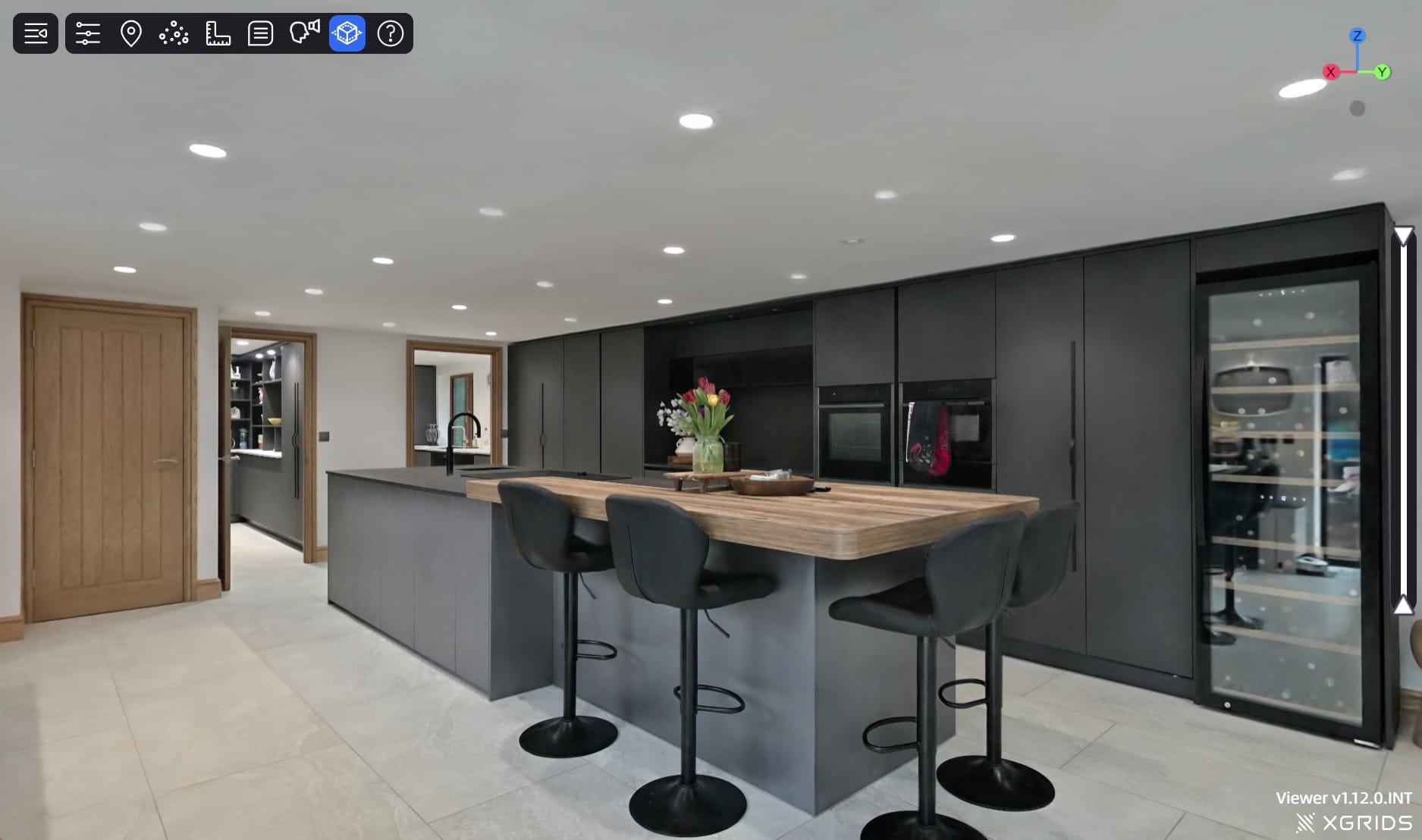
Creating a 3D Gaussian Splat (3DGS) model follows a structured workflow: data capture, dataset preparation, training and export. A Gaussian Splat model represents a scene using millions of 3D ellipsoids, known as “splats.” Each splat carries a 3D position, a covariance describing its shape and orientation, an opacity value, and a view-dependent colour. Rather than building mesh geometry, the scene is rendered directly from these splats using GPU rasterisation.
1. Data Capture — The Most Critical Stage
Data capture determines model quality and typically represents the majority of the effort on any project.
Ground capture: we use a high-resolution camera with manual exposure, manual focus, a fixed focal length and locked white balance. When recording video we shoot in 4K minimum, maintain strong parallax and move through the space to create depth variation rather than relying on simple left-to-right pans.
Drone capture: we fly UAVs with large sensors and full manual controls, using slow, consistent paths to achieve 70–80% image overlap and capturing multiple altitudes for complete geometry. Manual exposure and focus are essential — automatic settings frequently cause reconstruction failures.
2. Dataset Preparation
Images or video frames are organised into a structured dataset ready for processing. Tool choice depends on dataset size, GPU capability, scalability requirements and budget — we work with a range of options including local GUI tools and cloud-based pipelines.
3. Training
Training is the core computational stage, where the system reconstructs the scene. Images with known camera positions are imported, initial splats are placed in 3D space, and optimisation algorithms iteratively adjust each splat's position, size, shape, colour and opacity to minimise the difference between the rendered result and the source imagery.
4. Export & Delivery
Once trained, the finished Gaussian Splat model can be exported for web viewing, VR/360 tours, or hosted on a standalone Grid Viewer — including on a USB 3.0 flash drive for offline use. The result is a photorealistic, explorable 3D asset that works for real estate, venue marketing, insurance documentation and construction inspection alike.